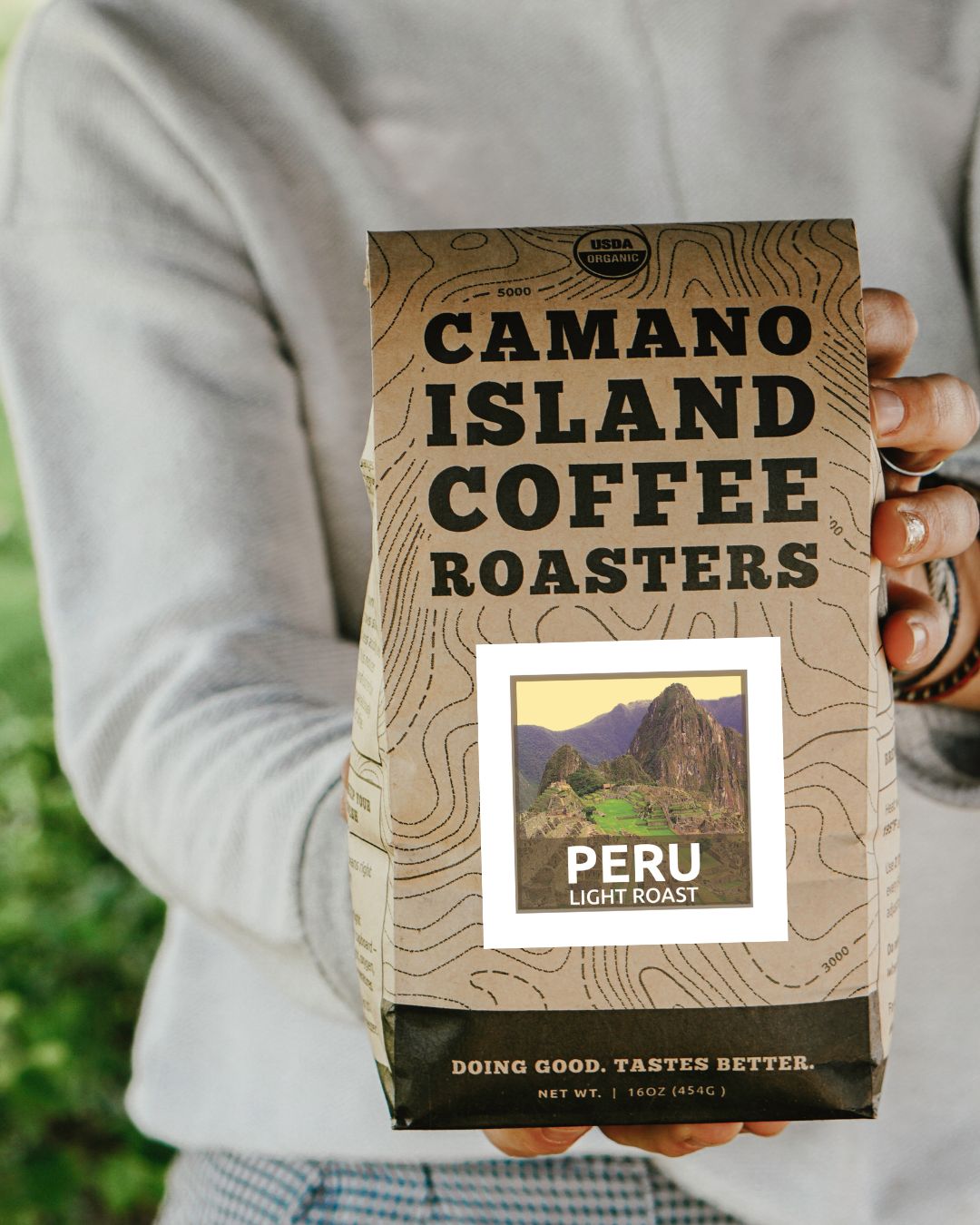
If you enjoy lighter coffees that are easy to drink yet full of flavor, our Organic Peru Coffee offers a clean and naturally sweet cup. Grown at one of the highest elevations in the region, this Peru bean develops bright, fruity characteristics that translate into a refreshing and approachable coffee.
This is our lightest bodied coffee, making it an excellent choice for those who enjoy drinking multiple cups throughout the day without the coffee feeling heavy. Despite its light body, the cup remains flavorful and satisfying, showing how elevation and origin can create sweetness and clarity without weight.
The aroma is bright and fruity, setting the stage for a delicate flavor profile. In the cup, you’ll find notes of almond and honey, complemented by hints of berry. The body stays light, and the clean finish leaves the palate refreshed and ready for the next sip.
When brewed, Organic Peru Coffee reveals a gentle and balanced flavor experience:
Aroma: Bright and Fruity
Flavor: Almond, Honey, Hints of Berry
Body: Light
Finish: Clean
These flavors come together naturally, creating a cup that’s smooth and pleasant without lingering heaviness.
Because of its light body and clean finish, this coffee fits easily into any part of the day. It pairs well with a variety of meals and works just as comfortably alongside breakfast as it does in the afternoon.
When it comes to coffee, taste is what draws most people in. But the way coffee is grown can make a real difference, not only in the cup, but in the health of the soil, the safety of farmworkers, and the long-term sustainability of coffee-growing regions. That’s why organic coffee farming practices matter, and why they’ve been at the core of what we support at Camano Island Coffee Roasters
Organic Coffee Avoids Synthetic Pesticides and Fertilizers
One clear difference between organic and non-organic coffee is the use of chemicals.
Organic coffee is grown without synthetic pesticides, herbicides, and fertilizers
Conventional farming permits the use of these chemicals to manage pesticides
While not all non-organic coffee farms rely heavily on synthetic inputs, organic certification provides a clearly defined and verified standard designed to limit chemical use.
Organic Farming Supports Healthier Soil
Healthy soil is essential for sustainable coffee production. Organic farms typically use:
Compost
Natural fertilizers
Crop diversity
Shade trees and ground cover
These methods help maintain soil structure, reduce erosion, and support nutrient-rich ground. Conventional farms may depend more on synthetic fertilizers, which don’t always support soil health in the same way.
Organic Standards Reduce Chemical Exposure for Farmworkers
Organic certifications prohibits synthetic chemical use. This means workers on organic farms aren’t regularly applying or handling these substances, reducing exposure to synthetic pesticides and chemical drift.
Organic Practices Help Protect Local Ecosystems
Coffee grows in regions with diverse plant and animal life. Organic growing methods avoid synthetic chemicals, which helps:
Keep waterways cleaner
Support beneficial insects and pollinators
Maintain healthier surrounding vegetation
Many organic farms also use shade grown techniques, which help preserve habitat and reduce the need for clearing forested areas.
Organic Growing Can Influence Flavor
Flavor depends on many factors: origin, altitude, processing, and roasting. But growing conditions matter too.
Organic farms often rely on slower growth cycles supported by nutrient-rich soil. These natural conditions can contribute to clean, balanced flavors because the coffee cherries mature at a steady, natural pace.
While organic certification doesn’t guarantee a specific flavor, many people find organic coffees have a smooth, clean cup character.
Choosing organic coffee supports farming systems that prioritize soil health, cleaner ecosystems, and safer conditions for workers. It also ensures your coffee is grown without synthetic chemicals, something more and more coffee drinkers.
At Camano Island Coffee Roasters, we source 100% USDA Certified Organic coffee because we believe great coffee starts with responsible farming. Supporting organic agriculture means supporting healthier land, healthier communities, and a long-term future for the coffee we all enjoy.
Why Ethical Sourcing Matters (Especially When It Comes To Your Morning Coffee)
Let’s be honest, coffee is more than just a drink. It’s how most of us start our day, find a moment of calm, or share time with others. At Camano Island Coffee Roasters, we believe coffee should not only taste good, it should do good too. That’s where ethical sourcing comes in.
Our journey started here on Camano Island, Washington, in a little barn with a big vision: could coffee become a force for good? Our founder, Jeff Ericson, was deeply moved after learning about the challenges facing coffee farming families. Families who often work incredibly hard but still live in poverty. He didn’t want to sell just great coffee. He wanted to create change.
So we set out to do coffee differently, from how we source our beans to how we support the communities growing them.
What does “ethical sourcing” really mean?
For us, it means choosing to put people and the planet first, every step of the way. Here’s what that looks like for us:
100% Organic, Shade Grown Beans
All of our coffee is certified organic and shade grown. That’s good news for the environment and even better news for you, because healthier soil and slower growing beans create richer, smoother flavors.
Fair Pay for Farmers
We pay above fair trade rates and work closely with growers through long term relationships. This ensures farmers are not only compensated fairly but also have the stability they need to thrive and plan for the future.
Giving Back Through Every Bag
We partner with incredible nonprofits like Agros Internationaland Food 4 Farmers. A portion of every Coffee Lovers Club order supports initiatives like land ownership, diversified farming, clean water access, and education. It’s not just charity, it’s long term empowerment.
When we started Camano Island Coffee Roasters, we asked ourselves: Can a cup of coffee really make a difference? The answer, we’ve learned, is yes, when it’s sourced the right way. When you sip our coffee, you’re part of something bigger than just your morning routine.
We work with amazing farmers in places like Central and South America who are doing things right, growing their beans with care, using sustainable methods, and putting their families and communities first. Thanks to partners like Agros International, many of these farmers are able to own their land, support their children’s education, and build lasting independence. That’s the kind of impact we want to be a part of, and it’s the kind of coffee we want to drink.
Screenshot
Most people don’t think about where their coffee comes from (understandably, it’s early in the morning!). But when you choose ethically sourced coffee, you’re making a small choice with a big ripple effect:
You’re helping farmers get paid fairly for their hard work
You’re protecting the environment and supporting clean farming practices
And yes, you’re getting a fresher, better tasting cup of coffee
We’re proud to roast the top 1% of Arabica beans, all certified organic and shade grown. And we’re even prouder to say we know exactly where they come from, and who we’re supporting with every bag.
What started as a barn-based dream has grown into a community of coffee lovers who believe that what we drink, and how it’s sourced, matters. Our customers aren’t just here for a caffeine fix. They care about where their coffee comes from. They believe in fair pay, clean farming, and real impact. And we love that about you.
Ethical sourcing isn’t a trend for us. It’s the foundation of who we are.
So the next time you brew a cup of Camano Island Coffee, know this: you’re supporting farmers, protecting the planet, and helping us build a coffee industry that works for everyone, not just the biggest players.
We’re no strangers to the occasional comments and rolling of eyes when it comes to our “Coffee Snobbery” at CICR. We all enjoy grabbing our coffee and taking it with us when we visit others, go on vacation, or just head for a short drive. We’ve also become very aware that many of our customers do the same thing!
Next time you hear a friend/family member make a comment about “the coffee snob you’ve become” or joke with you about your obsession with coffee, just think about this…
The coffee is GREAT, Organic, Shade-grown, and fairly traded – and that plays a part… but how often can you carry your favorite beverage with you and know that you’re changing the world as you move about through life?
Once you’ve thought about it, offer to make them more than a coffee snob. Tell them the story and share a cup or two… or some beans. If they join our Coffee Lover’s Club, you’ll get a free shipment, but more importantly, you’ll have added another person to the arsenal of people changing lives through responsible purchasing daily!
That’s the reason we roast/ship/drink our coffee after all!
An Ethical Coffee Meeting with Agros International
This past Wednesday, Dan and I had the opportunity to visit Agros HQ in Seattle. It was a great time and they were very hospitable to us. We were able to share some of the new things CICR has been working on. Many new faces (for me at least) were there for the meeting.
Our customers all know of our close relationship with Agros as we talk about it all the time. Just as it’s important for us to communicate to you the changes you create through being members of our Coffee Lover’s Club, it’s also important for us to spend time communicating our focus on ethical coffee with Agros as well. For us, giving Agros a check from our Coffee Lover’s Club orders is only a sustainable act if we can also communicate with Agros and allow them to communicate back. Knowing of Agros’ future goals is part of responsible giving and ethical coffee. Allowing Agros to communicate their goals back is part of responsible receiving. We’re so happy to have a wonderful relationship with Agros.
Dan brought his camera and took a few pictures in between making Frozen X-plosion’s and serving brewed coffee.
The table we sat at had a wonderfully colorful tablecloth. Emily at Agros provided Dan and I very delicious sandwiches! Shannon grabbed Dan’s camera when he came out with the Frozen X-plosion’s for everyone and took a couple great pictures: Here are a few of the Agros workers enjoying Frozen X-plosion’s. The purpose of our visit was for me to share CICR’s vision for ethical coffee with Agros and “update” them on the things happening around CICR. All-in-all, we had a great time celebrating ethical coffee and sustainability.
If you could change the world on your own, what would you change? Why would you change it? I ask myself that question often.
It baffles me that the new “richest man in the world” comes from a nation with many poor individuals. Using the current idea of “charity” in America, to most of us it would seem like “the right thing to do” would be for an individual with a lot to give to those with nothing. That idea, however, is exactly the opposite of what would help those in need. You see, giving to those in need is a great idea and will help them in the moment. Unfortunately, for being such a “great idea”, it actually can make things worse by causing a dependency. The long term, however, is left untouched which brings them back to the same problems they had in the beginning.
I personally give to Agros because of one reason alone. I believe in sustainability. Not just the buzz-word that seems to be tossed around. No, I believe in something much more than being a “good neighbor” or being “generous”. I’d much rather give $5 to something that will create change for more than a day than $50,000 into something that will change lives for 1 day and allow them to fall back into poverty as soon as the money is gone.
Here’s an interesting fact. For only $10,000, Agros is able to break the cycle of generational poverty for one family. Why donate to something that will grant dreams for a moment when you can contribute to something that will grant dreams for a lifetime?
It’s so easy – Purchase our ethical coffee and enjoy the wonderful flavor of creating sustainable change!
ReThink Coffee – Sustainable Coffee Program for Organizations and Churches
We wanted to take this opportunity to announce our newest venture with Agros. ReThink coffee is a new way to look at your organization or church missions program. Instead of purchasing coffee that keeps people in a cycle of poverty and then giving money out to various missions, ReThink coffee offers a better way to do real missions work.
Many people do not understand that coffee is the second largest commodity in the world… next to oil. While we can’t make much of a difference with our oil purchases – we can all make a huge difference in our coffee purchases. If every coffee drinker were to be more responsible in their coffee purchases – poverty in many of the world’s rural areas would be overcome.
We use the term “The coffee that helps you sleep at night” because every time you purchase coffee… you know that you are helping third-world farmers on their path to sustainability. This work allows us to truly “Teach a man to fish” instead of “giving a man a fish”. When we help a family through loans and education to first own their own land this gives them the opportunity to have hope for their future and as a direct result of our support for the products they grow they now have life. When we give them a handout or a short-term fix, fear is created because they don’t know who to go to tomorrow.
As Americans, we must change our thinking from “is this the best price for coffee?” to “will this small amount of money be multiplied to create the most good in the lives of the people who earn it?”
For more information please go to www.agros.org and remember whenever you purchase your next package of coffee, make sure it is certified organic…shade grown…and fairly traded.
Thanks for coming along with us on this journey of responsible consumerism – and remember next time you are re-thinking your coffee selection…there is really a coffee that helps you sleep at night.
If you’re interested in getting coffee for your organization or you are looking for a new church coffee program, please visit ReThink Coffee’s website to buy ethical coffee.
This is a daily question we hear from churches and non-profit organizations. The answer is simple… Quit asking for donations and start providing something of value while telling the CICR story of “creating change while doing good“.
We have many groups that are creating latte drinks as a fundraiser and even more that are making Frozen X-plosion at fairs, festivals, and events while telling customers that they are willing to work to create change in the world around them.
Gone are the days where you can hold your hand out and be showered with money from heaven. The same principal of working for our rewards is now becoming prevalent in the charitable industry. When we work for our money, we become better stewards of where that money goes. It seems like a new idea but it’s been around forever.
We get hundreds of calls a month asking for a donation for worthy causes around the world. Wouldn’t it be great if we could get inspired to make our own money for charity!? At CICR we say “We make the fuel that runs the engine of change”. We don’t know how to go to third-world countries and teach people to get in control of their destinies but we do know how to roast great, ethical coffee and sell it. When we sell coffee, we create a few more drops of fuel that can keep the Agros engine running longer.
In closing, I’d like to make this challenge to you…
Let’s ALL get inspired to take on the challenge of sustainability.
Lets NOT create problems by being irresponsible in our purchasing in order to save a little money here and there and alleviate our consciences by throwing that extra money we saved at a charity.
Let’s CREATE CHANGE through responsible purchasing and sharing that same message with others.
Together, with hard work, we really can save the world!
“Give a man a fish and you feed him for a day. We’ve all heard this saying. We’ve also heard, “Teach a man to fish and you feed him for a lifetime.” Here at CICR we like to take this saying a step further. Let me show you.
“Give a man a fish? What if he could own the pond?
Western culture’s concept of charity is generally “Give a man a fish.” Some take this a step further, and “Teach a man to fish.”
Here at CICR, we’re a little more entrepreneurial than that. We want to, “Teach the man to own the pond!” If a man owns the pond he not only changes his life but the lives of his children and grandchildren. Land-ownership eliminates poverty — generationally.
Owning the pond: Sustainable Agriculture.
Through our partnership with Agros we can help the man own the pond. Agros provides land-ownership programs to farmers in developing countries. Now, before you ask, Agros doesn’t just give them the land. No way. That’s “Give a man a fish.” That’s not sustainable. Instead Agros provides the financing to purchase the land — at low interest or no interest at all. Within 7 years whole villages of farmers have “deed burning” parties — celebrating their status as landowners.
As Agros supporters, we’ve seen the entrepreneurial results of dollars invested in these communities. It’s amazing to see how so much can be accomplished with so little. Check out Agros.org to see for yourself.
While giving a person money is generous, it is not always wise. When you help people with the proper training and give them the opportunity to own their own land -watch out! The human spirit takes over and change happens!
But What Has This Got To Do With Ethical Coffee?
For every shipment of coffee we send out we give $1 back to Agros. By giving to Agros with every shipment we tie this model of charity directly to you — the consumer. You become part of this process. With something as simple and beautiful as a cup of coffee you can be a part of redefining charity in the 21st century. With every sip you generationally change farmer’s lives. That’s ethical coffee!
That’s why we would love for you to be a part of the process. Let’s face it. You’re going to buy coffee anyway. Why not be a part of a greater movement. Don’t just write a check during the Holidays! That’s like “Give a man a fish.” Be a part of sustainable agriculture in the developing world — “Teach him to own the pond!”
Thank you for your help!
Jeff – CICR
Want to do more than “Give a man a fish?”
Click below and we’ll send you a sample of free coffee to get you started.








 This is a daily question we hear from churches and non-profit organizations. The answer is simple…

